
Minnie Maud Recovery

Minnie Maud is an eating disorder recovery method developed by Gwyneth Olwyn.  It has since been rebranded as the Homeodynamic Recovery Method.  The website with all of the pertinent information can be found here. What follows is my own analysis of the method and a brief overview of my successes with it.

MinnieMaud Guidelines are the guidelines for recovery from restrictive eating disorders such as anorexia, binging/purging, bulimia, orthorexia and any EDNOS involving food restriction that I followed in recovery. The “Minnie” refers to the Minnesota Starvation Experiment and the “Maud” refers to the anorexia family based treatment program, the Maudsley protocol.

The guideline’s food amounts are what energy-balanced, non-eating-disordered people normally eat to maintain their health and weight. Meaning your minimum intake guidelines are what you can expect to eat during AND after recovery. However, you can expect to eat far more than minimum intake during the energy-restoration part recovery. (AKA extreme hunger).

The way to successfully follow the MinnieMaud program is to:

  1. Eat the minimum intake every single day. It is a minimum intake and you are both encouraged and expected to eat more. Never restrict food intake. Your minimum intake is between 2500-3500 depending on your age, height, and gender and can be found on her website.
  2. No weighing yourself or measuring yourself. This is the easiest way to relapse, so just avoid it completely. While I was gaining weight, I covered mirrors, threw away my scales, and bought loose flowing dresses that would fit me even when I was bloated or heavier. All of these things were crucial to me being okay with the weight gain and getting through the hardest part.
  3. No exercise.  At all.

The MinnieMaud guidelines believe that restrictive eating disorders are neurobiological conditions. The condition can be either active or in remission, but it is never completely cured.  Part of remission is addressing the anxiety and guilt you associate with food head on with a therapist to avoid repeating inappropriate response behaviors to eating such as over exercising or restricting food.

So, the three steps to recovery are:

  1. Weight restoration – to your SET POINT.
  2. Repairing and reversing physical and metabolic damage.
  3. Developing new non-restrictive neural patterns in response to usual anxiety triggers.

These steps can all be achieved through following the program.

your-eatopiaI discovered Minnie Maud over a year before I finally committed to it.  The one predicament about this method is that you have to want recovery for yourself in order to successfully go through with it.  When I found the program, it was still available on the original Youreatopia site.  I haunted the site and forums for months as I unsuccessfully attempted to recover through quasi recovery.  When I finally found a therapist who supported Minnie Maud and I committed at the beginning of 2015. My whole world began to change and by the end of that year I was finally in remission.


Clearly MinnieMaud worked for me.  I still consider myself in remission to this day.  After I started eating the minimums within a few weeks extreme hunger hit me and for the next month and a half to two months I was eating between 5000-10000 calories a day, sometimes more.  It was like I had a hunger deep inside me that could never be satisfied.  Then that eventually calmed down and I kept eating to the minimums. I love the concept of a minimum intake because it completely flipped the script from what I had been implementing for years.  Instead of being afraid of going over a certain number, I now had absolutely no limit!  It is a freeing feeling.  I felt the healing relationship to food.  I felt the physical transformation.  I felt the eating disorder disappear into the furthest, darkest corner of my brain.

2015
Left: Jan 2015, just deciding to do MM. Sad, thin, empty, confused, miserable. Right: Sep 2015, VERY happily enjoying my summer 9 months into MM and 4 dress sizes bigger. Happy, social, free.

If you are considering this method of recovery I cannot recommend it highly enough.  If you are still not sold, do the research on it yourself.  That’s what I did and it was more than enough to convince me.  People can say what they want about Minnie Maud but they cannot argue with a success story like mine and the many others out there.  The best way to fight food restriction is with food.  Food is medicine, it keeps us alive, and none of us are born with issues about it. MinnieMaud finally allowed me to remember what it was like to have a normal relationship with food and my body, it taught me so much about being a kinder compassionate human both to myself and to others.  It allowed me to find myself again after years of hiding being an eating disorder and for that I am eternally grateful.


The Minnesota Starvation Experiment

The Minnesota Starvation Experiment was a study done by Ancel Keys in the late 1940s to study the effects of famine on war torn countries in Europe post World War Two.  Besides fulfilling its intended purpose – the study also ended up shedding the first light on how dieting and food restriction effects the human body.

Here is an overview of how the experiment worked:

image

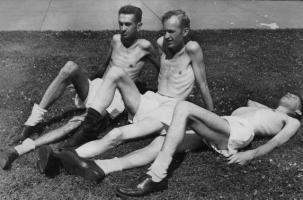
The subjects were all men.  First, they were studied under a 12-week control period in which they were fed a standard diet of 3200 calories.  During this time their psychological and physiological states were measured in order to determine each subject’s baseline condition.  At this phase each man was at their natural weight, which they all maintained on the control diet they were fed.

The next phase was the starvation period. For the following 24 weeks all of the men’s diets were cut by approximately half to 1570 calories per day.  It was during this phase that the behavior of the subjects began to change drastically.  They all began presenting symptoms that we commonly associate with chronic dieters or anorexia sufferers today.  Some of the symptoms observed included:

  • A decrease in strength and energy
  • Apathy towards everything except for food
  • A sudden and intense interest in food displayed through reading cookbooks for fun and to stare at the pictures
  • They took advantage of being allowed to chew gum by chewing packs and packs of it per day, and they guzzled coffee and water to stave off feelings of hunger
  • They became irritable around meal times
  • Many men became depressed
  • They lost weight (obviously)
  • Their heart rates decreased
  • They felt dizzy
  • They felt lethargic
  • They were constantly cold
  • Almost all subjects experienced body dysmorphic disorder and were unable to recognize how much weight they had actually lost

starvation-experiment_main


The next phase of the experiment was the recovery period.  The men were split into four subgroups and each group ate a different caloric intake to recover from the symptoms of starvation.  The first group ate 1970 calories, the second 2370 calories, the third 2770 calories, and final the fourth ate 3170 calories.  Even with the increase in calories all of the men were still left feeling hungry or starving.  These increased intakes were not helping and specifically the men in the lowest group were not feeling better AT ALL.  In light of this discovery Ancel Keys decided to add 800 calories to each groups intake.  Eventually he observed that the only factor helping these men recover was providing them way more food than he initially thought would be necessary.  He concluded that a person needs at least 4000 calories a day to recover and rebuild their strength.

After the recovery period was over the men were free to eat whatever they pleased, but Keys continued to observe a small handful of them.  He observed that most subjects continued to eat thousands and thousands of calories a day (12,000+ in some cases) for many months.  Many subjects reported to have an unending, insatiable, hunger months after the experiment ended.  As the subjects allowed themselves to re-feed through eating to their extreme hunger, their metabolisms began to heal, their strength returned, and many of the symptoms of starvation began to vanish.  Although to the layman it may appear that these men were massively “overeating” it became extremely evident that their bodies requires this seemingly inordinate amount of food to fully heal all of the damage.

On average the men regained their weight back to what it had been previously plus 10%.  You may identify this as an overshoot.  With unlimited food and unrestricted eating eventually their weight plateaued and about nine months later all of them were back to the weight they had been at the very beginning of the experiment.  This is one of the first documented and analyzed cases of a body’s “set point.”  Despite the original fear that all of this unrestrained eating would cause infinite and exponential weight gain, that proved to not be true.  This experiment demonstrated that over eating and starvation induced hunger only presented as long as a body was below its set point.

And that was the Minnesota Starvation Experiment.  It’s fascinating because just a cursory analysis of the study demonstrates how insanely harmful caloric restriction is on the human body. As you may note, all of the symptoms that the men experience in the starvation phase are eerily similar the symptoms felt by eating disorder sufferers and chronic dieters.  Sadly, most people who struggle with a disordered relationship to food today are often eating even less than the subjects of this study were.  A typical dietary recommendation for people seeking to lose weight is often a caloric total lower than the 1,580 calories the study subjects ate.  It is important to recognize that these “dietary guidelines” are dangerously low, unsustainable, and unrealistic amounts that should not be practiced.

Furthermore if you are stuck trying to recover from yo-yo dieting, binging and purging, restrictive eating, or any other disordered relationship to food this study gives you an excellent blue print for how to recover.  This was the science that I read when I decided to go all in on recovery using the Minnie Maud method.  This science validates that method of recovery (and now so does my own lived experience with it).

Please feel free to watch my video below for a synopses of the information above along with an outline of my own experience and my results from using this method to recover from anorexia.

Quasi-Recovery

Quasi-recovery is a point in recovery where weight has been restored, but your body and mind have not been fully healed.  It is a halfway point to real recovery.  While you may be at a “healthy” weight, you may not be at the right weight for your body.  You might be in quasi-recovery if you are still fixated on calories and are still restricting (even if your restricting to higher amounts like 2000-2500 a day), if you’re exercising for the purposes of maintaining your weight, if you have not given into extreme hunger or mental hunger, if you still have a fear of gaining weight, or if the ED voices have not stopped.

DC5F2300-D471-46C8-979B-DCD96637AB0B
Top picture – Summer 2014, Deeply in quasi recovery, exercising to maintain my weight, counting and restricting calories, still feeling trapped by food Bottom picture – Summer 2017 in full recovery for almost 2 years, little to no exercise, unlimited calories, free of all eating disorder behavior/thoughts

I was stuck in quasi-recovery for over a year.  I was convinced I was recovered because I had gained a few pounds, could eat more calories, and wasn’t starving myself anymore.  But the truth is I was just as sick as ever, still obsessed with numbers and worried about maintaining my weight. The obsessive thoughts hadn’t stopped and that was because I had not truly let myself recover.  The most dangerous thing about being in this state is that it is very very easy to relapse because you are on the edge of letting yourself truly recover, and falling back into old habits.  I relapsed several times during my quasi-recovery. When you’re here your body still hasn’t found its homeostasis that it can happily maintain because the truth is, when you’re in quasi recovery your metabolism hasn’t healed.  Even though you’re eating more, you’re still restricting your body from what it needs to find it’s set point which is why you will gain weight on lower numbers.  The only way to stop this is to truly recover.

To truly recover means to give into the mental hunger, to stop restricting any calories by eating at least 3500 a day, to stop working out, and to let your body gain more weight than you may be initially comfortable with.  As you know if you are familiar with me, my blog, or my youtube channel I recovered this way using the minniemaud method.  The information that this approach derived its methodology from was the Minnesota starvation experiment.  This experiment was the only in-depth study on calorie restriction’s effects and how re-feeding works.  Following the logic of minniemaud is what allowed me to finally decide to truly recover and it is through my own personal experience and the experience of many other girls I met through my journey that I can confidently say it is the only way you will ever truly free yourself because if you are stuck in quasi, you are not truly free.

Will you gain weight in real recovery? Yes.
Will you overshoot your set point? You might.
Will you experience extreme hunger? Definitely, although how intense and for how long depends on how intensely and for how long you were restricting yourself.
Will you finally be set free of the control numbers and food has over your life? Yes.
Will you claim your life, soul, and energy back? 100%
Will your body eventually naturally settle at its set point? Absolutely.

Quasi recovery is a dangerous place to be.  If you are there then it is time to take your life back and take the dive into a full and honest recovery now.  The longer you stay in quasi, the longer and harder a real recovery will be.


New Years Resolutions (That Aren’t Weight Loss)

New Years Resolutions.  Every year we see people around this time of year resolve to make a change in the next year, and unfortunately that change usually surrounds weight loss.  Thousands of people determined to shed what they consider unnecessary weight typically through methods that are dangerous manifestations of the corporate, money grubbing, health ignorant, diet culture pervasive in our society.

Instead of resolving to change your beautiful body why not focus on something else this year?  I’ve compiled a few ideas here.

Save Money
This is a great resolution because it’s easy to keep track of.  At the end of the year it’s so gratifying to check your savings account and see your success!  Plus you gain something valuable through it.

giphy

School Related
Maybe your aiming to work hard to get into college, or a graduate program.  Maybe you need to focus on getting straight A’s all year.  Achieving academic success is valuable, productive, and a good goal to execute.

the fairly oddparents dancing GIF

New Hobby
Perhaps you want to start playing an instrument, or learn how to cook, or become really skilled at makeup?  These are all great resolutions to work on!  Starting a skill you’ve always wanted to master is an excellent and worthwhile goal.

kris jenner hobby GIF

Eco Friendly
You could make the decision to switch to veganism for the earth, the animals, and yourself.  You could work on reducing your trash waste or converting to minimalism.

cat vegan GIF

Mental Health
You could practice positive self affirmations and body positivity by working to truly love and accept your body for all that it is and all that it does for you.  You could decide to seek help from a therapist, or vow to be more open about your struggles.

health GIF

Finally, if you are suffering from an eating disorder this is the year that your resolution is to truly and honestly recover.  No more quasi, no more excuses, no more reasons to wait.  Recovering from an eating disorder started with a NY resolution for me in 2015 and in that year I started Minnie Maud, gained all my weight back, graduated from college, met amazing friends, had unforgettable experiences, started my career, and met my boyfriend.  There is no greater choice than the choice to recover and get your life back.  Make your year 2018.

No matter what your 2017 was like, it’s time to look ahead – and when you pick a resolution (if you even want to) make sure you focus on the things in life that matter, your relationships, your mental health, your personal growth and development and not the things that don’t – your weight, size, or shape.

Navigating The Holidays in Recovery

This week is American Thanksgiving which means lots of food, and lots of nosy relatives asking you insensitive and intrusive questions.  If you are someone recovering from an eating disorder, any Holiday that is hallmarked by food can be difficult and triggering.  When I was sick I definitely wanted to avoid these situations.  But oftentimes you can’t and in truth you shouldn’t.  The Holidays are not only about decadent food, they are also about taking the time to reconnect with your loved ones and enjoy each others company.  It’s a shame to sacrifice that for any reason.

Here are a few tips I have for navigating this time – they can also be applied to any other time you are in a triggering or difficult food situation.

1 – Find a friend. Whether it’s a parent, cousin, sibling, or grandparent – find someone you trust who you can confide your fears to so you don’t feel isolated.  Tell them you are recovering from an eating disorder.  It is okay to let people in.  There is no shame in what you are going through.  This person can also hold you accountable and make sure that you eat – perhaps by filling their plate with the same food as you and having you both eat it together.

2 – DO NOT COMPENSATE. You don’t have to have a full on binge to have a successful Holiday, but if you do find that you eat an above average amount of food please remember that that is 100% NORMAL and you should not feel guilty, gluttonous, or sad.  Food is yummy – holiday food is really yummy – and eating a lot of it is never wrong.  That being said, do not eat less in preparation for this meal and do not eat less or nothing the next day in a compensatory way.  Doing this not only sets your metabolism out of whack but also isn’t a healthy way of thinking about food and is a behavior you should be consciously working to correct anyways.

3 – When anyone makes a comment about your weight – positive or negative, do not internalize it. I know it can be hard to hear but others do not know what you are going through.  I usually find that when someone is making comments on my weight or food choices it’s coming from a place of insecurity within themselves, which is sad but has nothing to do with you.  Just try and remember that when it happens.

4 – Finally, be kind to yourself. I know that your disordered eating voice will be screaming at you when you face big fear foods, and you are so so brave for fighting through them in order to nourish yourself and enjoy your life.  You can do this.  You are strong and beautiful.

It isn’t easy to face your fears.  It’s not silly or stupid to be afraid of a slice of pie, or helping of stuffing.  However, it is irrational and counterintuitive so working through these fears is a must as you move forward in your recovery.

Have a happy Thanksgiving I hope you find these tips helpful!  Let me know your favorite dish down in the comments!  Mine is probably mashed potatoes, but my absolute favorite thing in the world is my mom’s apple pie.

If you can, please take a moment to like and subscribe to my youtube channel – I make videos discussing intuitive eating, eating disorder recovery, body positivity, veganism, and self love!

Why 3500 Calories?

Before I begin this article/website is where I learned it all.

I’ve had a few people reach out to me asking how to eat 3500 calories a day when the mere idea seems impossible.  I’ve also been asked why is this number the minimum.  These are questions I once remember having and are echoed a lot throughout this community since coming from a place of restriction can make this number seem overwhelming.

First, why 3500 calories? 3500 is the number laid out in MinnieMaud recovery guidelines (now referred to as the homeodynamic recovery method).  The logic on that website is sound but let me break down my interpretation of it.

An average human being needs anywhere from 1700-2700 calories a day just to maintain their weight while living their normal every day life.  This is affected by how much you move around all day like if you have kids (or cats) or walk around a lot for work or school.  It’s also affected by your natural metabolism which is different for everyone.  Like, my boyfriend could pound this many calories and literally have 0 fluctuation in his weight whereas other people (like me) aren’t so lucky.  When weight restoring obviously you want to put on weight by eating above your maintenance number and 3500 is that magic number.

But Rachel, you say, I am weight restored to a healthy weight already!  I did it on 1800 or 2200 or X number of calories, so obviously this minimum doesn’t apply to me, right? WRONG.  Here is the thing… you only were able to gain weight on those numbers because you’re metabolism was so suppressed – and I’m speaking from experience here.  A big part of the minimums is that it also aids in repairing the suppressed metabolisms that people who restrict give themselves.

It is very easy to get stuck in quasi recovery instead of eating enough because the natural inclination is to assume that if you are weight restored back to a normal weight then you are recovered and need to start restricting calories again to avoid getting huge.  That’s an ED fueled thought process my friends. When you eat at least the minimums every day you won’t get stuck in the quasi-recovered state that usually leads to relapse and instead you will find your optimal weight set point.

When recovering there is a backlog of caloric deficit that needs to be replenished.  This was studied in one of the most fascination studies of starvation of the human body, the Minnesota Starvation Experiment.  The minimums were designed to help replenish the months (or years, or decades) of caloric deficit that has accumulated and reverse all of the negative physical effects like losing your period, feeling cold, hair falling out, compromised organs, etc, etc.

Once you hit your body’s optimal weight set point (not just “weight restored” according to the bullshit BMI) then the metabolism is normalized and that means that the extra energy you were taking in for weight gain and repair now goes to the usual day-to-day functions that were not happening at all from the moment you first restricted calories.

Now that we’re clear hopefully on WHY 3500 – let’s focus on HOW.

Three words: Calorie. Dense. Foods.

Try to incorporate avocadoes, cheese, ice cream, nut butters, coconut milk, dates, olive oil, nuts, dried fruit, pasta

Now I know that a lot of these foods might be “fear foods” for a lot of you – they certainly were for me.  It may not easy to face these foods head on – but this is recovery and if not now, then when?  Try one a day, see how it makes you feel.  Focus on the positives and load on up.  It’s easier if you just rip the bandaid and do it.

Here’s a few more tips:

Nuts, seeds, and dried fruit make a great addition to salads, rices dishes,pasta dishes, etc…

Add olive oil and butter to as many foods as possible. I.E.: rice, sandwiches, salads..

Increase portion sizes – Create larger meals of calorie dense foods like rice, mashed potatoes, and pasta.

Drinks are an easy way to intake calories.  Drink juice, soy milk, smoothies, shakes, and other healthy high calorie beverages.

Example meal plan (with rough estimates):

B: oatmeal with milk, nut butter, dried fruit, banana, nuts = 730
S: avocado toast = 450
L: double layer sandwich with hummus, protein, oil soaked veggies, cheese = 670
S: mixed nuts and chips = 300-500
D: pasta, veggies, protein, tomato sauce, olive oil – 600-700
S: after dinner shake with bananas, soy milk, nut butter, sweetener – 450 chocolate – 100

3500+ BOOM