
Minnie Maud Recovery

Minnie Maud is an eating disorder recovery method developed by Gwyneth Olwyn.  It has since been rebranded as the Homeodynamic Recovery Method.  The website with all of the pertinent information can be found here. What follows is my own analysis of the method and a brief overview of my successes with it.

MinnieMaud Guidelines are the guidelines for recovery from restrictive eating disorders such as anorexia, binging/purging, bulimia, orthorexia and any EDNOS involving food restriction that I followed in recovery. The “Minnie” refers to the Minnesota Starvation Experiment and the “Maud” refers to the anorexia family based treatment program, the Maudsley protocol.

The guideline’s food amounts are what energy-balanced, non-eating-disordered people normally eat to maintain their health and weight. Meaning your minimum intake guidelines are what you can expect to eat during AND after recovery. However, you can expect to eat far more than minimum intake during the energy-restoration part recovery. (AKA extreme hunger).

The way to successfully follow the MinnieMaud program is to:

  1. Eat the minimum intake every single day. It is a minimum intake and you are both encouraged and expected to eat more. Never restrict food intake. Your minimum intake is between 2500-3500 depending on your age, height, and gender and can be found on her website.
  2. No weighing yourself or measuring yourself. This is the easiest way to relapse, so just avoid it completely. While I was gaining weight, I covered mirrors, threw away my scales, and bought loose flowing dresses that would fit me even when I was bloated or heavier. All of these things were crucial to me being okay with the weight gain and getting through the hardest part.
  3. No exercise.  At all.

The MinnieMaud guidelines believe that restrictive eating disorders are neurobiological conditions. The condition can be either active or in remission, but it is never completely cured.  Part of remission is addressing the anxiety and guilt you associate with food head on with a therapist to avoid repeating inappropriate response behaviors to eating such as over exercising or restricting food.

So, the three steps to recovery are:

  1. Weight restoration – to your SET POINT.
  2. Repairing and reversing physical and metabolic damage.
  3. Developing new non-restrictive neural patterns in response to usual anxiety triggers.

These steps can all be achieved through following the program.

your-eatopiaI discovered Minnie Maud over a year before I finally committed to it.  The one predicament about this method is that you have to want recovery for yourself in order to successfully go through with it.  When I found the program, it was still available on the original Youreatopia site.  I haunted the site and forums for months as I unsuccessfully attempted to recover through quasi recovery.  When I finally found a therapist who supported Minnie Maud and I committed at the beginning of 2015. My whole world began to change and by the end of that year I was finally in remission.


Clearly MinnieMaud worked for me.  I still consider myself in remission to this day.  After I started eating the minimums within a few weeks extreme hunger hit me and for the next month and a half to two months I was eating between 5000-10000 calories a day, sometimes more.  It was like I had a hunger deep inside me that could never be satisfied.  Then that eventually calmed down and I kept eating to the minimums. I love the concept of a minimum intake because it completely flipped the script from what I had been implementing for years.  Instead of being afraid of going over a certain number, I now had absolutely no limit!  It is a freeing feeling.  I felt the healing relationship to food.  I felt the physical transformation.  I felt the eating disorder disappear into the furthest, darkest corner of my brain.

2015
Left: Jan 2015, just deciding to do MM. Sad, thin, empty, confused, miserable. Right: Sep 2015, VERY happily enjoying my summer 9 months into MM and 4 dress sizes bigger. Happy, social, free.

If you are considering this method of recovery I cannot recommend it highly enough.  If you are still not sold, do the research on it yourself.  That’s what I did and it was more than enough to convince me.  People can say what they want about Minnie Maud but they cannot argue with a success story like mine and the many others out there.  The best way to fight food restriction is with food.  Food is medicine, it keeps us alive, and none of us are born with issues about it. MinnieMaud finally allowed me to remember what it was like to have a normal relationship with food and my body, it taught me so much about being a kinder compassionate human both to myself and to others.  It allowed me to find myself again after years of hiding being an eating disorder and for that I am eternally grateful.


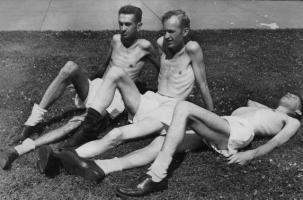
The Minnesota Starvation Experiment

The Minnesota Starvation Experiment was a study done by Ancel Keys in the late 1940s to study the effects of famine on war torn countries in Europe post World War Two.  Besides fulfilling its intended purpose – the study also ended up shedding the first light on how dieting and food restriction effects the human body.

Here is an overview of how the experiment worked:

image

The subjects were all men.  First, they were studied under a 12-week control period in which they were fed a standard diet of 3200 calories.  During this time their psychological and physiological states were measured in order to determine each subject’s baseline condition.  At this phase each man was at their natural weight, which they all maintained on the control diet they were fed.

The next phase was the starvation period. For the following 24 weeks all of the men’s diets were cut by approximately half to 1570 calories per day.  It was during this phase that the behavior of the subjects began to change drastically.  They all began presenting symptoms that we commonly associate with chronic dieters or anorexia sufferers today.  Some of the symptoms observed included:

  • A decrease in strength and energy
  • Apathy towards everything except for food
  • A sudden and intense interest in food displayed through reading cookbooks for fun and to stare at the pictures
  • They took advantage of being allowed to chew gum by chewing packs and packs of it per day, and they guzzled coffee and water to stave off feelings of hunger
  • They became irritable around meal times
  • Many men became depressed
  • They lost weight (obviously)
  • Their heart rates decreased
  • They felt dizzy
  • They felt lethargic
  • They were constantly cold
  • Almost all subjects experienced body dysmorphic disorder and were unable to recognize how much weight they had actually lost

starvation-experiment_main


The next phase of the experiment was the recovery period.  The men were split into four subgroups and each group ate a different caloric intake to recover from the symptoms of starvation.  The first group ate 1970 calories, the second 2370 calories, the third 2770 calories, and final the fourth ate 3170 calories.  Even with the increase in calories all of the men were still left feeling hungry or starving.  These increased intakes were not helping and specifically the men in the lowest group were not feeling better AT ALL.  In light of this discovery Ancel Keys decided to add 800 calories to each groups intake.  Eventually he observed that the only factor helping these men recover was providing them way more food than he initially thought would be necessary.  He concluded that a person needs at least 4000 calories a day to recover and rebuild their strength.

After the recovery period was over the men were free to eat whatever they pleased, but Keys continued to observe a small handful of them.  He observed that most subjects continued to eat thousands and thousands of calories a day (12,000+ in some cases) for many months.  Many subjects reported to have an unending, insatiable, hunger months after the experiment ended.  As the subjects allowed themselves to re-feed through eating to their extreme hunger, their metabolisms began to heal, their strength returned, and many of the symptoms of starvation began to vanish.  Although to the layman it may appear that these men were massively “overeating” it became extremely evident that their bodies requires this seemingly inordinate amount of food to fully heal all of the damage.

On average the men regained their weight back to what it had been previously plus 10%.  You may identify this as an overshoot.  With unlimited food and unrestricted eating eventually their weight plateaued and about nine months later all of them were back to the weight they had been at the very beginning of the experiment.  This is one of the first documented and analyzed cases of a body’s “set point.”  Despite the original fear that all of this unrestrained eating would cause infinite and exponential weight gain, that proved to not be true.  This experiment demonstrated that over eating and starvation induced hunger only presented as long as a body was below its set point.

And that was the Minnesota Starvation Experiment.  It’s fascinating because just a cursory analysis of the study demonstrates how insanely harmful caloric restriction is on the human body. As you may note, all of the symptoms that the men experience in the starvation phase are eerily similar the symptoms felt by eating disorder sufferers and chronic dieters.  Sadly, most people who struggle with a disordered relationship to food today are often eating even less than the subjects of this study were.  A typical dietary recommendation for people seeking to lose weight is often a caloric total lower than the 1,580 calories the study subjects ate.  It is important to recognize that these “dietary guidelines” are dangerously low, unsustainable, and unrealistic amounts that should not be practiced.

Furthermore if you are stuck trying to recover from yo-yo dieting, binging and purging, restrictive eating, or any other disordered relationship to food this study gives you an excellent blue print for how to recover.  This was the science that I read when I decided to go all in on recovery using the Minnie Maud method.  This science validates that method of recovery (and now so does my own lived experience with it).

Please feel free to watch my video below for a synopses of the information above along with an outline of my own experience and my results from using this method to recover from anorexia.