To Exercise Or Not To Exercise?

That is the question… Should you exercise in recovery?  The short answer is no.

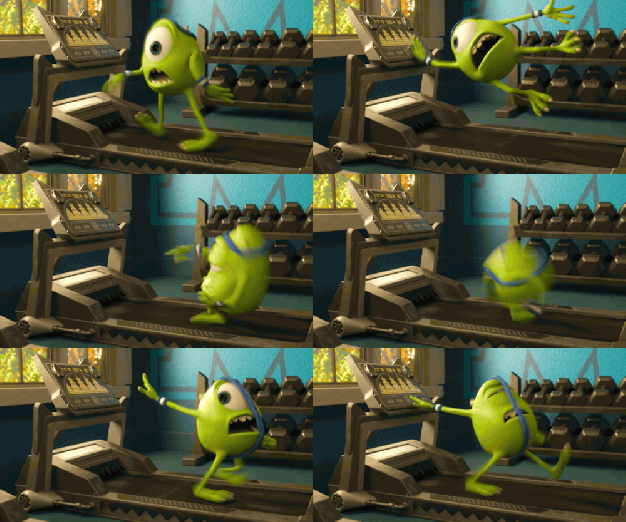
For those recovering from disordered relationships to their bodies and food, exercise is a bad idea.  Exercise burns calories and the goal of eating disorder recovery is weight restoration, so doing any exercise to slow or impede this process goes directly against any recovery efforts.  Another goal of recovery is to regain or discover a healthier mentality about your body and food.  Trying to burn calories in this process can keep you stuck in a mindset that isn’t beneficial.  It is true that there is more to exercising than just burning calories such as becoming stronger with weight training or more centered with yoga, however those benefits will still be there and can be reaped AFTER recovery has been achieved and maintained.
giphy-2

In my recovery, I went through a few phases of “quasi-recovery” before I fully committed to a robust recovery plan which you can read about in this post.  In my “quasi-recovery” state I continued to exercise.  I was exercising less than when I was sick but the mentality behind my exercise was still dangerous.  I was still counting calories and aiming for a deficit.  I was still trying to stall the weight gain.  I was using exercise as a crutch to keep me from truly letting my body heal and find its set point.  When I finally made the very difficult and complicated decision to truly recover and eat without any restrictions I made the equally difficult decision to stop exercising completely as well.

At first it was challenging, I found myself doing pushups and squats absentmindedly in my bedroom to compensate for the guilt I felt not working out.  Eventually I stopped even that and truly let my body rest for the first time in a long time.  As the weight came back on and my body changed, my mindset began to change too.  I slowly but surely learned that exercise was just a way I was punishing my body for what I ate.  I learned to love myself and enjoy all of the things that recovery brought back into my life.  I needed that time of complete rest to truly understand how exercise was not good for my recovery.
IMG_0745

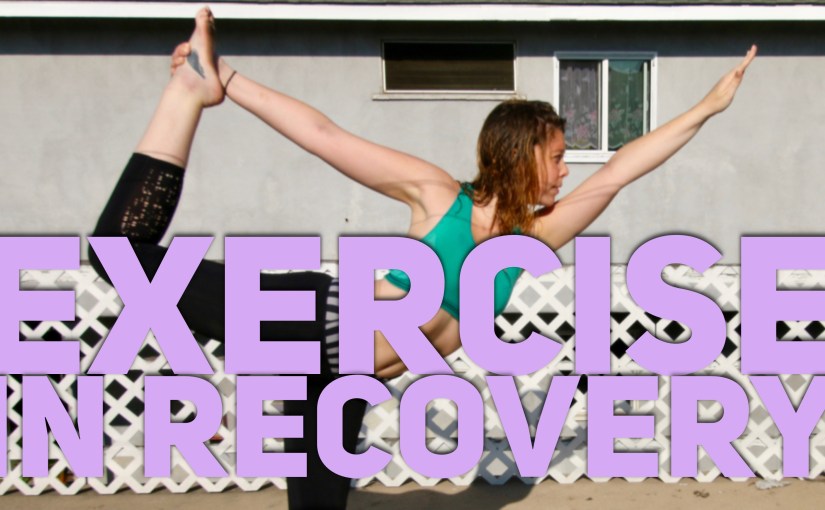
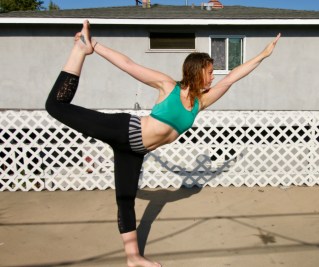
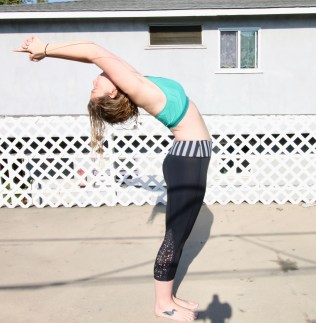
It wasn’t until I was fully weight restored to my set point and mentally recovered for an entire year that I began to wonder about exercising again. This time however, I noticed a very important difference in my mindset.  I didn’t want to punish myself, burn off all of my fat, or create any kind of deficit.  I wanted to move my body with love and celebrate what it could do.  I began doing yoga again.  I have been doing yoga for a few months now and not once have I felt “too fat” or “not good enough.”  Not once has weight loss been my ultimate goal.  I can feel myself getting stronger and more flexible and I look at myself in the mirror as a powerful warrior who has won the battle.

However, despite all of my progress I can never forget that I have a history with eating disorders.  As great and body positive and happy as the workouts make me now, I know that there is always a chance the anorexic voice can creep back in.  If I ever feel like I need to shed the weight, if I ever force myself to a class I really don’t want to do just out of guilt, and if I ever start to abuse exercise again I know I need to completely stop.

Exercise can be wonderful if done safely and as a celebration of movement and strength, but for those attempting to recover from an eating disorder none of those benefits are pertinent.  The key to recovery is to eat without restriction, stop all exercise, and learn to be okay with yourself without making any changes to who you naturally are.
IMG_0739

Namaste

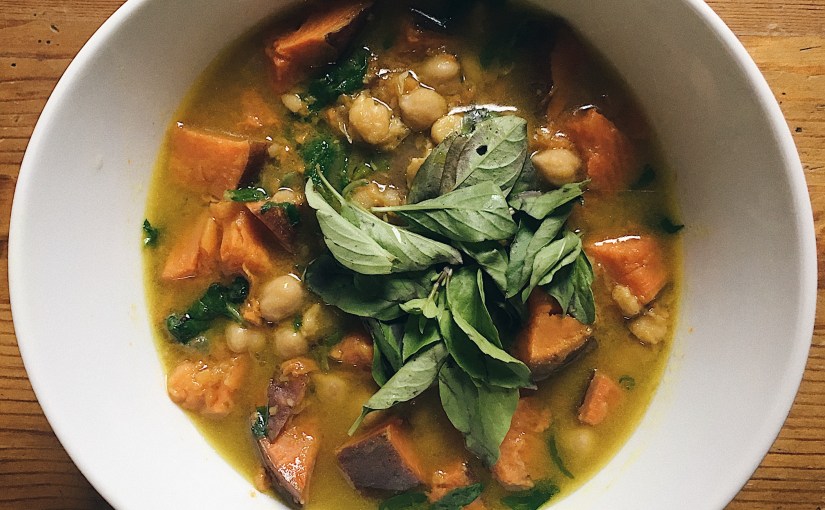
Sweet Potato Thai Green Curry – Recipe Video

Today I’d like to share the first of what I hope are many recipes to come.  I filmed this on Monday night after I came home from work.  This is one of my many simple and quick dinners that I make after a long day.  While I typically pre-make most of my meals, one or two nights out of the week I feel inspired to play around in the kitchen a bit.

One of the best parts of recovering from an eating disorder is the freedom that I have in the kitchen.  When I was sick I would have had to weigh the sweet potato, and measure out exactly how much coconut milk, olive oil, and chickpeas I used.  To be honest, I probably wouldn’t even cook with some of these ingredients because they are too calorically dense.  After recovery, all of that fear is just a distant memory.  Now I can experiment, estimate, make mistakes, and I know everything will be okay.  This has allowed me to become a better amateur chef and a happier person.

I hope you enjoy this meal as much as I did!  I think I actually preferred it heated up the next day.  It is super filling, nutritious, and it is vegan!  (I am not vegan – but this is!)

Bon Appetit!

Hey, if you liked this post (or any of my other ones!) try liking the Ladle By Ladle page on Facebook!  It’s a good way to stay up to date on the latest posts.

//pagead2.googlesyndication.com/pagead/js/adsbygoogle.js

(adsbygoogle = window.adsbygoogle || []).push({});

Orthorexia: The “Healthy Eating” Disorder

Let’s talk about orthorexia.  Sometimes called the accidental eating disorder, orthorexia is ironically when a person becomes SO obsessed with a “healthy” diet and lifestyle that it actually becomes unhealthy.  It is Human Makeover: Extreme Edition.  It’s obsession under the guise of health.  While someone who develops orthorexia might have started out with harmless intentions, they often end up in a very unhealthy place.

giphy-1

An orthorexic is often very concerned about the “purity” of their food.  They are fixated by the oils used in restaurants and potential toxins in their food.  They eat only a very small list of “acceptable” foods and are unable to eat food prepared by others.  They will become completely fixated on the quality of food, how to eat it, and when to eat it.  They will put themselves on strict eating regimens that most people could never stick to.  They want to be better than others by proving their dietary superiority.  If they have a slip up they will often self-punish with more exercise or less food.  Ultimately their food choices are destructively restricted and their exercise routine becomes so aggressive that their health suffers.

Orthorexia is not technically an eating disorder according to the DSM-5, but let’s be clear folks, this IS an eating disorder.  It was a phrase created by Dr. Steven Bratman in the late 90s.  He had patients who were overly health obsessed to the point of being harmful to themselves.  While it was not initially meant to be a diagnosis, over time he discovered that this term describes a very real eating disorder.

tumblr_mjqwmcm5x51riawrco1_500

Of course there is a difference between orthorexia and a normal healthy lifestyle.   The amount of stress and fixation that comes with orthorexia typifies the illness.  A person leading a healthy life without obsession or fear is not sick in the same way an orthorexic is.  While the line might be blurry orthorexics suffer from compulsive behaviors, preoccupations with optimal health, self-imposed anxiety, shame, and severe restrictions that escalate.  Orthorexics might attempt cleanses or fasts in order to “detoxify” their bodies.  While any disordered relationship with food is unhealthy, people can also suffer from nutritional deficits, self-inflicted social isolation, damaged relationships, and total loss of the ability to eat intuitively.  The biggest problem of all is that orthorexia is tricky to recover from.  We live in a society that idolizes healthy eating and thinness.  In this environment an orthorexic may not realize that they have a problem and can stay disordered under the pretense of a healthy lifestyle.

tumblr_inline_o3jfozI6ja1qg972v_540

So, if you think that any of this might apply to you… Start eating things that scare you, look at your attitude honestly, accept that you may not be the healthiest person in the world, and begin to re-learn how to love your body no matter what.  Stop measuring your self-worth by your overly restrictive diet and exercise routine, and learn how to eat intuitively.  Fill your body with joy and self-love and take a step back from unrealistic health goals that stop you from truly living a life worth living.  A life full of strong and happy friendships and relationships, a life with junk food and salads, wine and smoothies, ice cream and vegetables, happiness and joy, and no self-hate.  Orthorexia is an eating disorder to recover from – and recovery is worth it for you too.

Sweet Potato Sunday!

IMG_5395

Growing up I was always that kid that absolutely REFUSED to eat my vegetables.  I remember sitting at the kitchen table for hours while my mom forced me to have at least one bite of spinach.  My parents tried everything!  They covered the veggies with sauce or cheese, they tried to spruce them up to make them more interesting to me, but I was a very stubborn child.  I was set in my ways and refused to learn to like vegetables.  It’s ironic that now as an adult (or a larger child, as I often consider myself) I absolutely LOVE veggies!  I try and have a vegetable component in almost every meal, and one of my favorites is the sweet potato!

118-cartoon-sweet-potato-joke

Sweet potatoes are actually one of my absolute favorite foods of all time.  They are second in line behind my ever beloved oatmeal.  They include many essential vitamins, including B6, C, D, and A!  You basically cover all the important alphabetical vitamins in one serving of this fun vegetable!  That’s another thing – they’re a vegetable that tastes like a dessert!  What a serious win win.

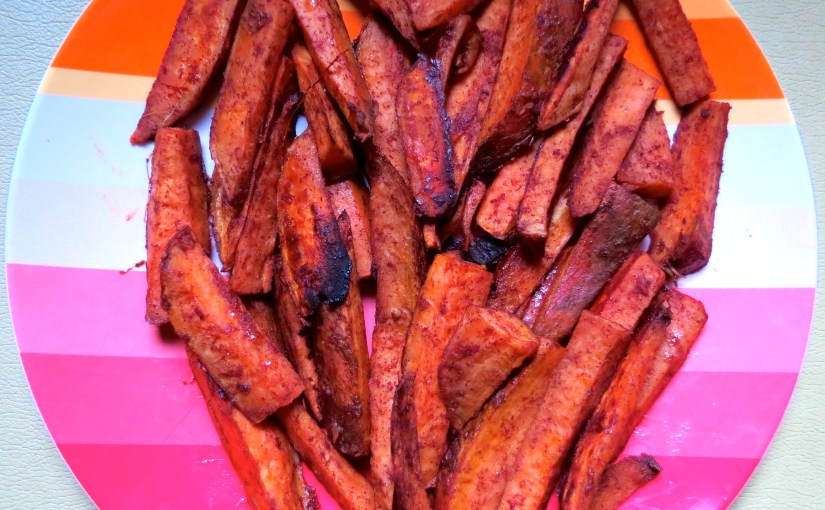
I buy tons of sweet potatoes every time I go to the store because they can store for a long time.  Whenever I don’t feel like cooking a big meal I simply wash a sweet potato, poke a few holes in if with a fork and microwave it for 8 minutes – rotating once at the 4 minute mark.  Then I can just cut it open straight from the microwave and load it up with whatever delicious fillings I want!  (Chickpeas, cheese, yogurt, honey, cinnamon sugar, nutella, or simply salt/pepper and butter!)  However, when I have more time I like to get a little fancier with my sweet potatoes and make myself some sweet oven baked fries!  The recipe is easy and the outcome is SO DELICIOUS OH MY GOSH!  You’ll just have to try it yourself to believe me!  (And this is also a great way to get some vital nutrients into picky kids!)

SWEET SWEET POTATO FRIES

The Ingredients:

1 large sweet potato (or 2 small ones)
1 tbsp olive oil
1 tbsp honey
2 tsp vanilla
1 tsp cinnamon

The Method:

1. Preheat oven to 375 degrees
2. Place sweet potato in microwave for 1-2 minutes so that it’s softer and easier to cut
3. Cut sweet potato into long fry-like strips and place into a bowl (I keep the skins on because I love them, but you can peel your potato if desired)
4. Add the rest of the ingredients of top of the cut potatoes and mix with your hands until each slice is fully covered and the ingredients have all mixed together
5. Spread out the strips onto a sprayed baking sheet
6. Place in oven for 30 minutes
7. Let cool for 5 minutes and then enjoy!