Minnie Maud Recovery

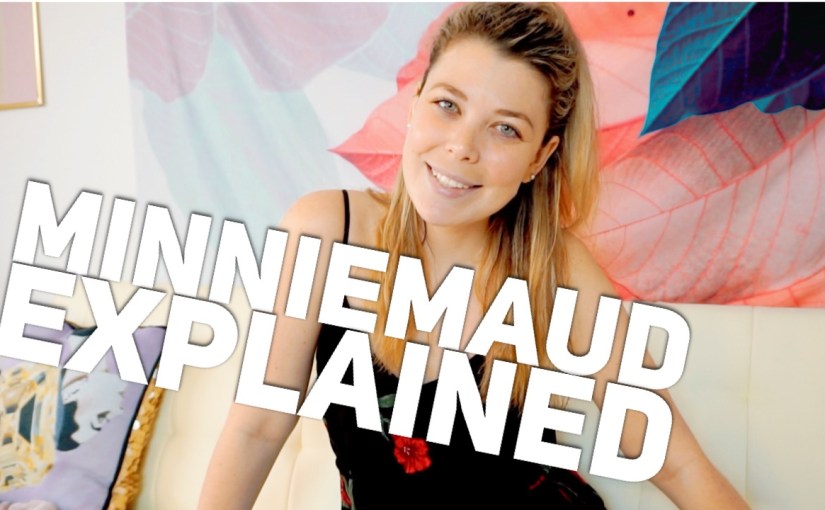
Minnie Maud is an eating disorder recovery method developed by Gwyneth Olwyn.  It has since been rebranded as the Homeodynamic Recovery Method.  The website with all of the pertinent information can be found here. What follows is my own analysis of the method and a brief overview of my successes with it.

MinnieMaud Guidelines are the guidelines for recovery from restrictive eating disorders such as anorexia, binging/purging, bulimia, orthorexia and any EDNOS involving food restriction that I followed in recovery. The “Minnie” refers to the Minnesota Starvation Experiment and the “Maud” refers to the anorexia family based treatment program, the Maudsley protocol.

The guideline’s food amounts are what energy-balanced, non-eating-disordered people normally eat to maintain their health and weight. Meaning your minimum intake guidelines are what you can expect to eat during AND after recovery. However, you can expect to eat far more than minimum intake during the energy-restoration part recovery. (AKA extreme hunger).

The way to successfully follow the MinnieMaud program is to:

  1. Eat the minimum intake every single day. It is a minimum intake and you are both encouraged and expected to eat more. Never restrict food intake. Your minimum intake is between 2500-3500 depending on your age, height, and gender and can be found on her website.
  2. No weighing yourself or measuring yourself. This is the easiest way to relapse, so just avoid it completely. While I was gaining weight, I covered mirrors, threw away my scales, and bought loose flowing dresses that would fit me even when I was bloated or heavier. All of these things were crucial to me being okay with the weight gain and getting through the hardest part.
  3. No exercise.  At all.

The MinnieMaud guidelines believe that restrictive eating disorders are neurobiological conditions. The condition can be either active or in remission, but it is never completely cured.  Part of remission is addressing the anxiety and guilt you associate with food head on with a therapist to avoid repeating inappropriate response behaviors to eating such as over exercising or restricting food.

So, the three steps to recovery are:

  1. Weight restoration – to your SET POINT.
  2. Repairing and reversing physical and metabolic damage.
  3. Developing new non-restrictive neural patterns in response to usual anxiety triggers.

These steps can all be achieved through following the program.
your-eatopiaI discovered Minnie Maud over a year before I finally committed to it.  The one predicament about this method is that you have to want recovery for yourself in order to successfully go through with it.  When I found the program, it was still available on the original Youreatopia site.  I haunted the site and forums for months as I unsuccessfully attempted to recover through quasi recovery.  When I finally found a therapist who supported Minnie Maud and I committed at the beginning of 2015. My whole world began to change and by the end of that year I was finally in remission.


Clearly MinnieMaud worked for me.  I still consider myself in remission to this day.  After I started eating the minimums within a few weeks extreme hunger hit me and for the next month and a half to two months I was eating between 5000-10000 calories a day, sometimes more.  It was like I had a hunger deep inside me that could never be satisfied.  Then that eventually calmed down and I kept eating to the minimums. I love the concept of a minimum intake because it completely flipped the script from what I had been implementing for years.  Instead of being afraid of going over a certain number, I now had absolutely no limit!  It is a freeing feeling.  I felt the healing relationship to food.  I felt the physical transformation.  I felt the eating disorder disappear into the furthest, darkest corner of my brain.
2015
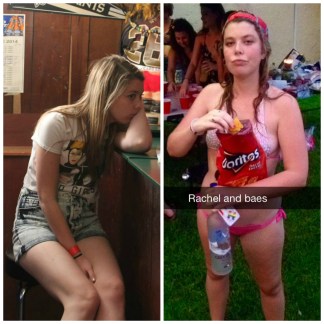
Left: Jan 2015, just deciding to do MM. Sad, thin, empty, confused, miserable. Right: Sep 2015, VERY happily enjoying my summer 9 months into MM and 4 dress sizes bigger. Happy, social, free.

If you are considering this method of recovery I cannot recommend it highly enough.  If you are still not sold, do the research on it yourself.  That’s what I did and it was more than enough to convince me.  People can say what they want about Minnie Maud but they cannot argue with a success story like mine and the many others out there.  The best way to fight food restriction is with food.  Food is medicine, it keeps us alive, and none of us are born with issues about it. MinnieMaud finally allowed me to remember what it was like to have a normal relationship with food and my body, it taught me so much about being a kinder compassionate human both to myself and to others.  It allowed me to find myself again after years of hiding being an eating disorder and for that I am eternally grateful.

Interview With Caroline Dooner – Creator of The Fuck It Diet

Untitled-design-12Recently I had the absolute pleasure of connecting with Caroline Dooner.  Caroline is the creator of The Fuck It Diet, which teaches radical normal eating to chronic dieters. She also teaches intuition and advocates hardcore for #rest. You can follow her on instagram, and get her free intro course, “Eating Should Be Easy” over on The Fuck It Diet.
When I was going through my own recovery I stumbled upon her website and it felt as if her words were speaking directly to me.  Caroline has been through the ringer of diet culture and found a way out that I strived to emulate.  Her writing and philosophies on making eating simple were such powerful sources of inspiration for me and many others trapped in diet culture.  Today she continues to help people through her blog, podcasts, and e-books.  She believes that eating should be easy because, fuck it, it’s just food right?

I was delighted when she agreed to answer some of my burning questions and it was wonderful to be able to get her seasoned perspective.

RR: Why the name “The Fuck It Diet”?

CD: It’s how I felt when I finally realized that dieting was backfiring and doing the opposite of what I have always hoped it would. It’s how I felt after being on diet after diet, hoping that the next one would finally heal my food addiction. It is the true exasperation of realizing it’s never going to work.

RR: What was the life event that inspired you to start the site?

CD: I had been dieting obsessively for 10 years. You could call it an eating disorder, or you could just call it obsessive dieting, there is a big overlap for lots of people anyway. But I was Paleo, and bingeing on all the paleo treats I could get my hands on, and finally started hearing whispers in the Paleo community, that not eating enough carbs will hurt your metabolism, and wreck your hormones, and make you more insulin resistant, which had been the thing I was trying to heal.

But the event/moment that spawned it, was my 24th birthday. I binged on squash pancakes and low sugar almond flour cupcakes, and had a legitimate epiphany. I can’t do this anymore. This is going to keep happening over and over and over, until I step out of this cycle, learn to eat normally, and heal my relationship to weight.

 I had tried to heal my eating many times before, going on stints of intuitive eating, or something similar. But it was never truly the cure, because I was still trying to eat the smallest amount possible, and still petrified of gaining weight. The Fuck It Diet was different.

RR: How long did it take for you to heal your relationship with food? 

CD: It was a process that evolved over the first few years of my no-holds-barred eating, and my work on deeper and deeper body acceptance. But I would say that between 6 months to a year is where I noticed a big shift.

Even still, just over the course of eating a certain food for a week would change my relationship with that certain food. So there were small victories, and then bigger shifts that happened over time.

RR: In your opinion, what you think the most negative impact of diet culture is?

CD: It’s really hard to choose just one, but diet culture puts you at odds with your body. The way you trust it, and your appetite, and your weight. It makes you totally out of touch with your own wisdom, intuition, cravings. And ruins your health and self-esteem.

RR: Do you think that diet culture is responsible for the rising rate of eating disorders?

CD: Hell to the yes.

RR: Your blog and podcast focuses a lot on spiritual healing – do you think it’s harder to recover if you aren’t spiritual?

CD: Ah yes, it’s such a good question. I have always been seeking guidance, or peace, or help, or knowledge on a spiritual level. And I know that is why and how TFID revealed itself to me. But there are some pretty basic facts and truths, like the biological and metabolic reaction to restriction. Even energetic principals aren’t necessarily “spiritual”. And I am expressly anti-dogma of any kind, diet dogma, spiritual dogma, or otherwise.

Trust in a bigger picture, and a bigger purpose than just being tiny and beautiful will certainly be a big help, but short answer: no. You don’t have to be spiritual to recover.

(pssst. she has a great podcast about this topic here)

RR: What would you say to girls who are afraid of this mindset because of their fear of getting “fat”?

CD: That this is what those businesses want you to fear. That that is just this heartbreaking thing that we have been perpetuating, and it’s so destructive and toxic. And I understand, I was the same way for years. Fat was the last thing I would ever accept being. It’s also because we have so many beliefs about what being fat means. But it’s just so misguided. What’s that JK Rowling quote? “is ‘fat’ really the worst thing a human being can be? Is ‘fat’ worse than ‘vindictive’, ‘jealous’, ‘shallow’, ‘vain’, ‘boring’ or ‘cruel’?”

RR: What is your most important tip to successfully practice intuitive eating?

CD: Do not get caught in the trap of believing you need to be eating the smallest amount possible. That’s a diet. We need to actually feed ourselves.

RR: What has been the most inspiring recovery story you’ve witnessed/had a hand in?

CD: It’s honestly too hard to choose, but in general, my favorite kind of story, and this happens again and again, is that healing from food and weight obsession, opens up a confidence and creative spark that allows people to really trust their own genius, go against the grain, choose a life that people might not understand. It let’s people really listen to their true desires.

RR: What is your number one piece of advice to someone struggling to recover/normalize their relationship with food?

CD: Do not discount how interconnected our relationship with weight is with our relationship with food. You cannot heal the one without the other.

RR: And finally, just for fun – what’s your favorite food?

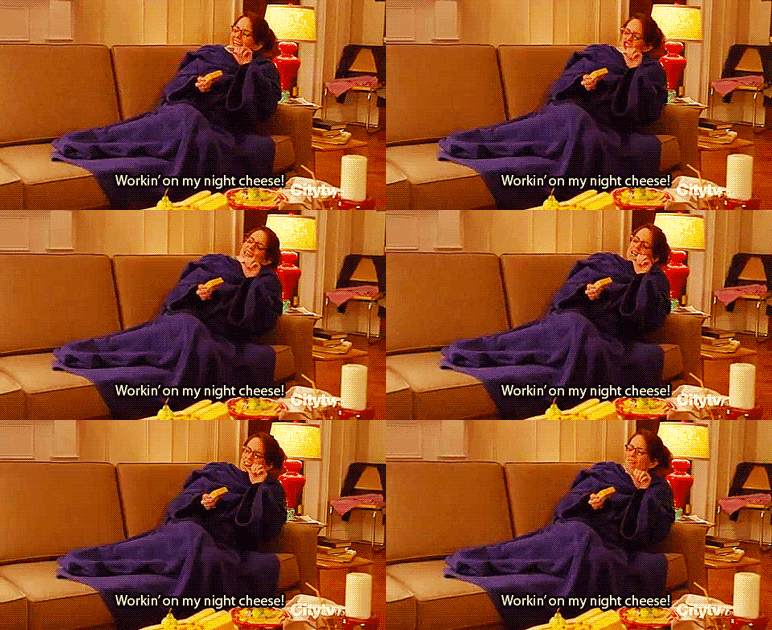
CD: My favorite food is cheese. No contest.

giphy

Huge thanks to Caroline for giving me the opportunity to pick her brain.  It meant a lot for me to be able to have this opportunity considering how incredibly helpful I found The Fuck It Diet and everything she put into it while I was struggling to recover.  If you’ve never heard of The Fuck It Diet – it’s about time you checked it out!

New to Ladle by Ladle?

Check out my Youtube channel where I make new videos about recovery, recipes, and intuitive eating: Ladle By Ladle

SOCIAL:
Instagram – @ladlebyladle
Facebook – facebook.com/ladlebyladle

Body Mass Index: The Meter of Lies

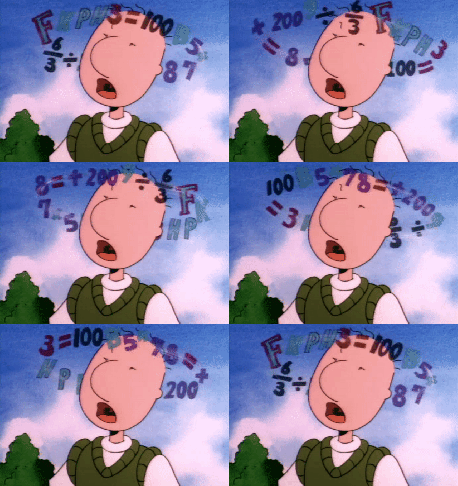
When suffering from an eating disorder numbers become a very integral part of life.  Weight, calorie intake, calorie output, and every number on every nutrition label are constantly circling the brain like a 90s cartoon character trying to do math.

giphy

Of course, there is also BMI.  BMI, short for Body Mass Index, is technically the measure of body fat using height and weight.  It calculates whether an individual is underweight, “normal”, overweight, obese, etc.  BMI is a widely used evaluation by doctors to assess a person’s health.  It is also a malicious meter of lies.  I was obsessed with my BMI while I was sick, before I realized that where I fell on the chart was not at all an accurate picture of my health or anyone else’s.

quetelet_adolphe
Pictured: actual evil wizard

First thing is first, the evil wizard who invented the BMI equation gave instructions to not use BMI the exact way we have been using it for decades.  Lambert Adolphe Jacques Quetelet (ridiculous name) said himself that the formula should not be used to suggest an individual’s “fatness”.  Instead the equation was meant to measure obesity throughout a population to help the government determine how to allocate resources.  He’s still an evil wizard in my book though for bringing the BMI into the world in the first place.

BMI does NOT account for gender, age, waist size, bone density, or muscle mass.  For instance, athletes and people with strong bones will often be classified as overweight or obese because bone and muscle are denser than fat.  Some of the fittest and healthiest #bodygoals you can think of including many body building competitors are technically obese?!?! That alone should tell you how grossly inaccurate this whole concept is.

The very notion of BMI suggests there are defined groups of underweight, ideal, overweight and obese people and that these groups have borders that are separated simply by a decimal place.  That is completely ridiculous.  Let’s just call a spade a spade,  BMI is bullshit.

Before I had an eating disorder a doctor looked me in the face and told me that I was overweight.  I went home with this information and internalized it.  At that time according to the BMI chart all I had to do was lose 2 pounds to be considered “normal”.  2 POUNDS! Perhaps, had I not been PMSing that day or had gone to the bathroom before my appointment the doctor would have never said that to me.  But he did, and I heard it.  I set my weight loss goal and got crackin’.  Then, long story short I went too far and ended up with anorexia.

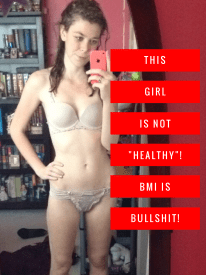
IMG_3328.PNGHere’s the thing about my eating disorder.  For the majority of the time I was sick, I was never “technically” deemed underweight according to the BMI chart.  An 18.5 or below is considered underweight and for the most part I hovered at 18.8.  My ED begged me to eat less and less to stay below that arbitrary threshold.  But while my hair was falling out, my bones were sticking out, my mental health was spiraling, and I was starving any doctor could have looked at me and told me that I was “ideal”!  Let me tell you, I was not.  Fortunately, now I don’t know my BMI and I honestly can’t even take the time to figure it out because I know that is a completely garbage number.

Let’s just all vow to never check our BMI again or let it dictate our behavior towards our bodies.  If a doctor tries to give you any advice based on it slap them!*

*Do not physically assault medical professionals, the slap should be figurative.


Hey, if you liked this post (or any of my other ones!) try liking the Ladle By Ladle page on Facebook!  It’s a good way to stay up to date on the latest posts.